Recruit is a SaaS desktop data-driven platform that streamlines clinical trial recruitment by matching complex protocol criteria with EHR data to surface high-quality candidates faster.
ROLE
Product designer
company
Clint Health
I was the sole designer, leading research, design, and iteration from discovery to launch. I collaborated with data science and engineering to reach the best solutions, followed implementation closely, and refined the product based on performance metrics and user feedback.
From 18 to 4 months
Time to reach recruitment goals was reduced by up to 30% reducing the total time from 18 to 4 months
20% less screen failure
The process reveled better quality candidates and up to 20% less screen failure rates in clinical trials
Understanding the industry and user's context
Clinical trial landscape
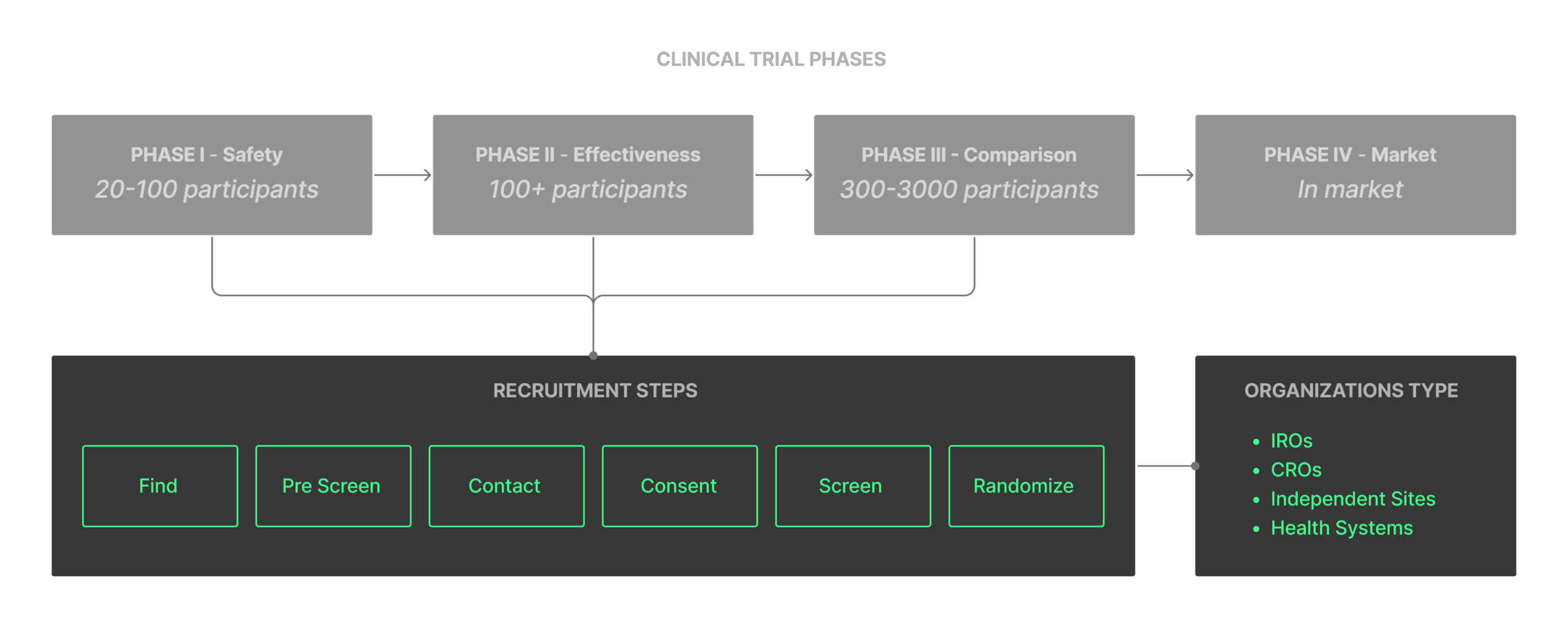
By combining my research with insights from a colleague experienced in clinical trial recruitment, I developed a deep understanding of the landscape in which the product would be used.
It includes, relevant HIPPAA regulations, clinical trial phases, different types of organizations within the recruitment space and their most common work hierarchy.
Inefficient workflows and high failure rates
User interviews revealed that their workflow was highly manual, involving complex navigation of EHR files for each patient and no standardized process for storing information, which was often kept in Excel sheets or even physical binders.
That process resulted in an unnecessarily high time spent in each participant, ranging from 15 to 45 minutes each and a high screen failure rate
Defining requirements and exploring the data possibilities
Identifying key requirements for multi-site research
Guided by business direction, we narrowed our focus to Integrated Research Organizations (IROs), which operate across multiple sites, trials and sponsors.
This focus helped us identify key requirements to support complex, multi-site trial management, such as:
Organizational structure
Support multiple sites running different trials.
Managerial needs
Provide trial-level metrics without exposing PHI.
Role-based access
Limit PHI visibility by role per HIPAA regulations.
Site-level boundaries
Restrict PHI access to each site and clearly separate data in the UI for compliance.
Determining the key features
Eligibility determination
The series of steps involved in determining participant’s eligibility
This is where the company’s data analysis capabilities had the greatest impact in saving users time by matching participants’ EHR data with specific trial protocols to show the most likely eligible candidates.
Status tracking
Where users keep track of the participant’s status while going through the eligibility determination.
Found the most variation here between sites, so we generalized each step to be usable across workflows, improving retention by reducing the need to manage work outside the platform.
Collaborating with data science to shape the experience
Understanding and exploring the possibilities of the data was key to the product’s success. We worked closely with the data science and engineering teams, translating UX research findings into actionable hypotheses.
Participant recruitment can be nuanced and often relies on clinical judgment rather than strict rules, we had to account for these gray areas when designing how data would surface in the workflow and how the back-end would support flexible, context-aware decision-making.
Designing and initial tests
Layout and features
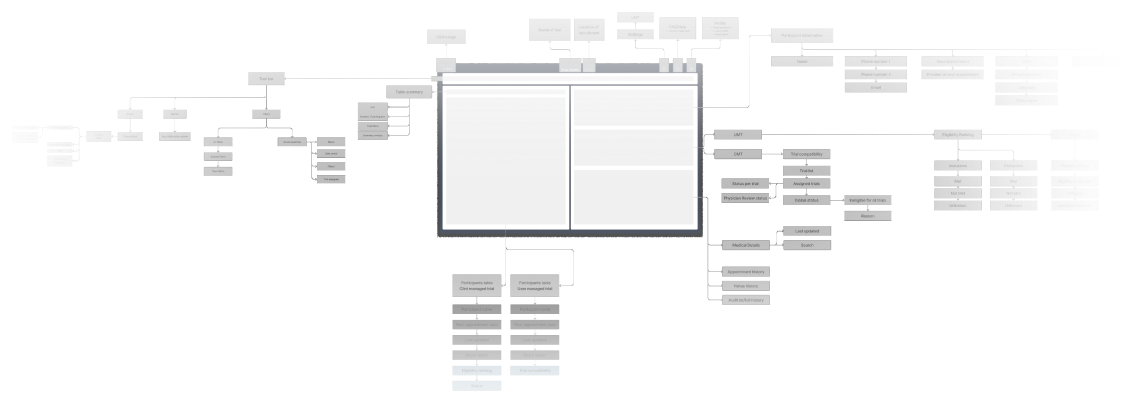
The UX flows revealed the need to have a large amount of information quickly available for users to analyze and quickly move between participants.
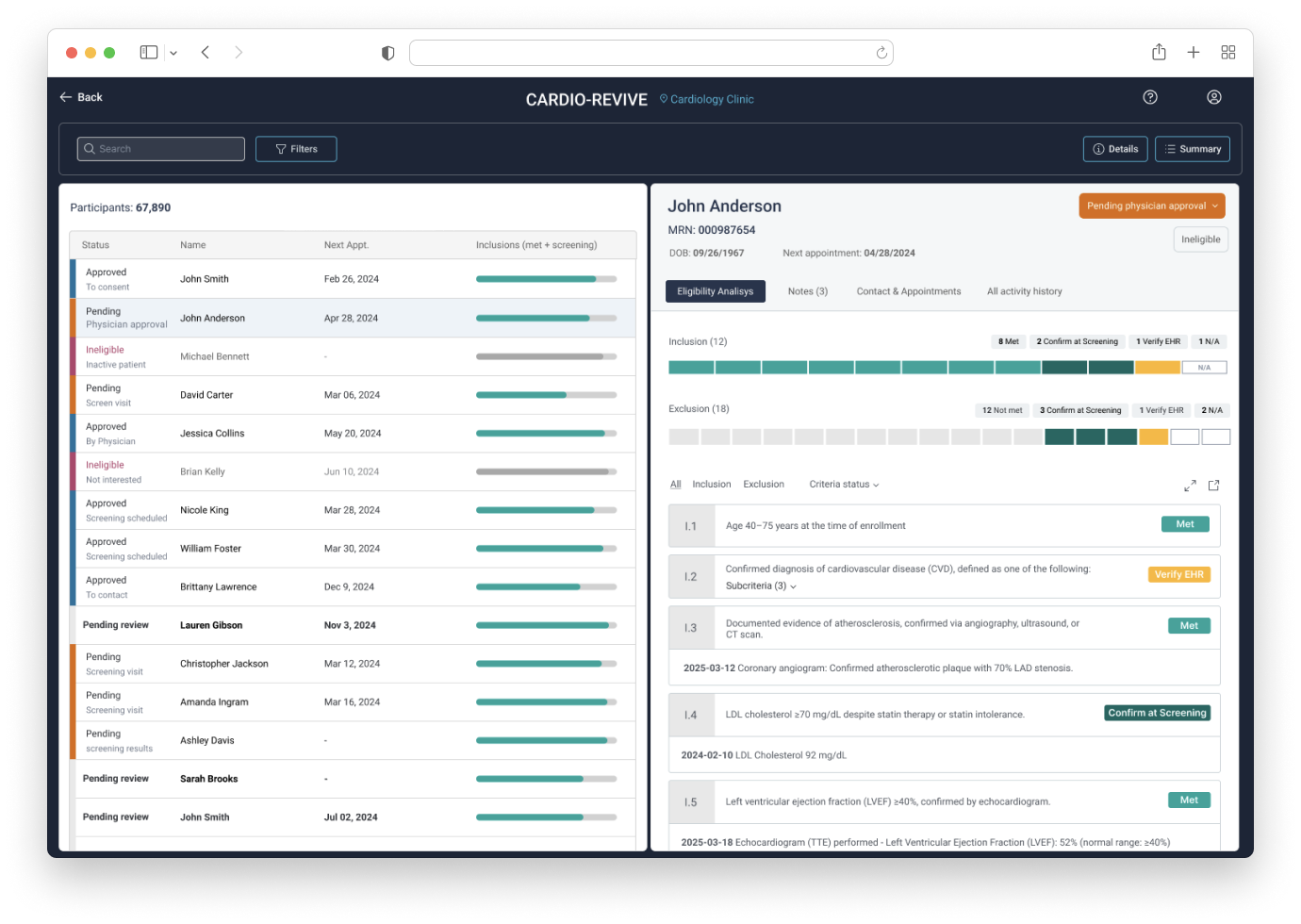
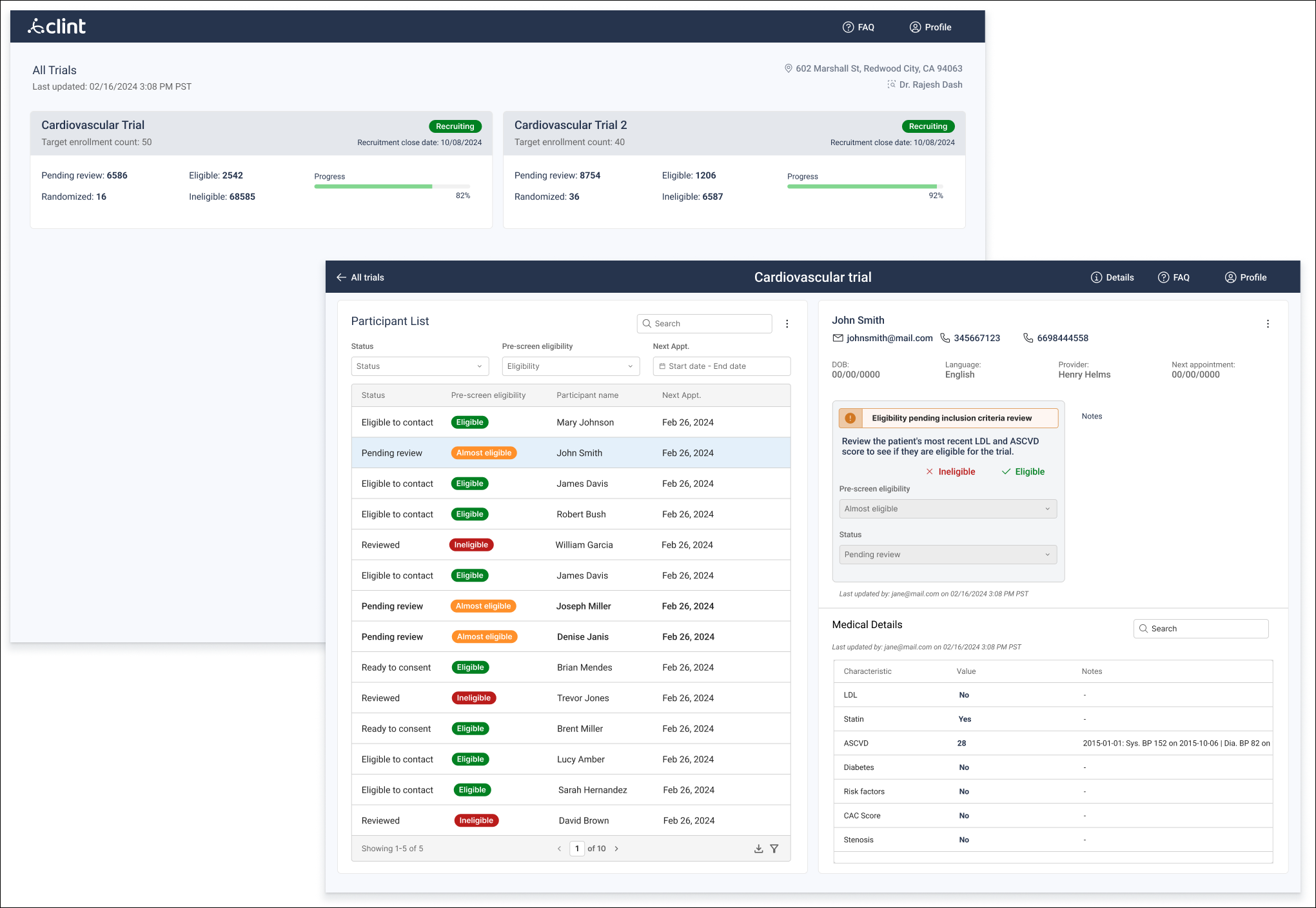
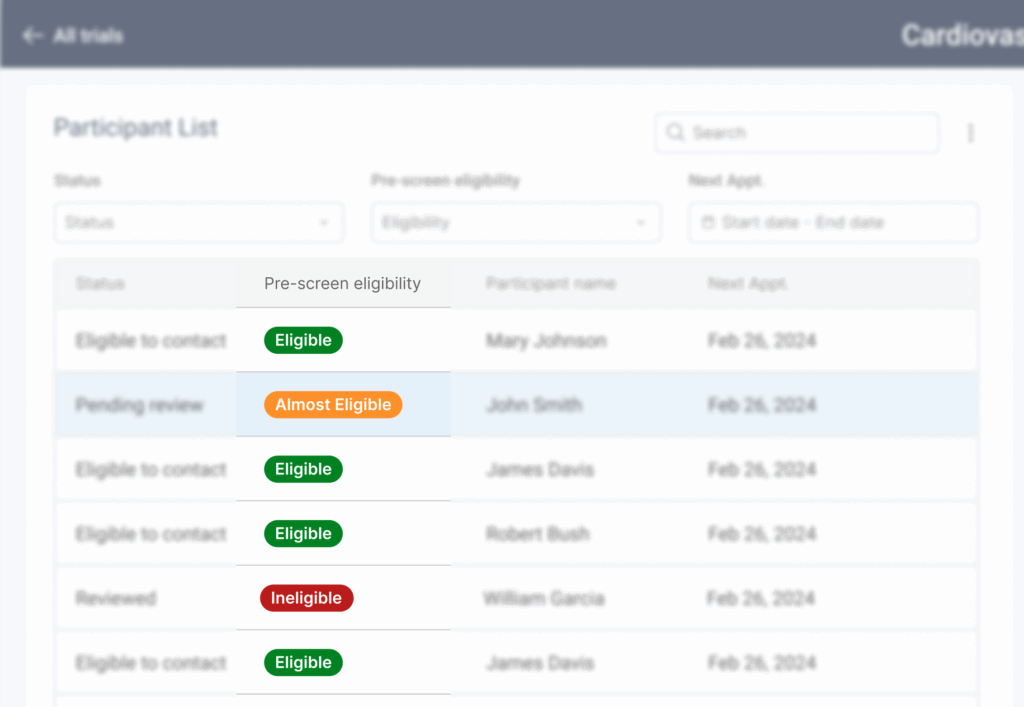
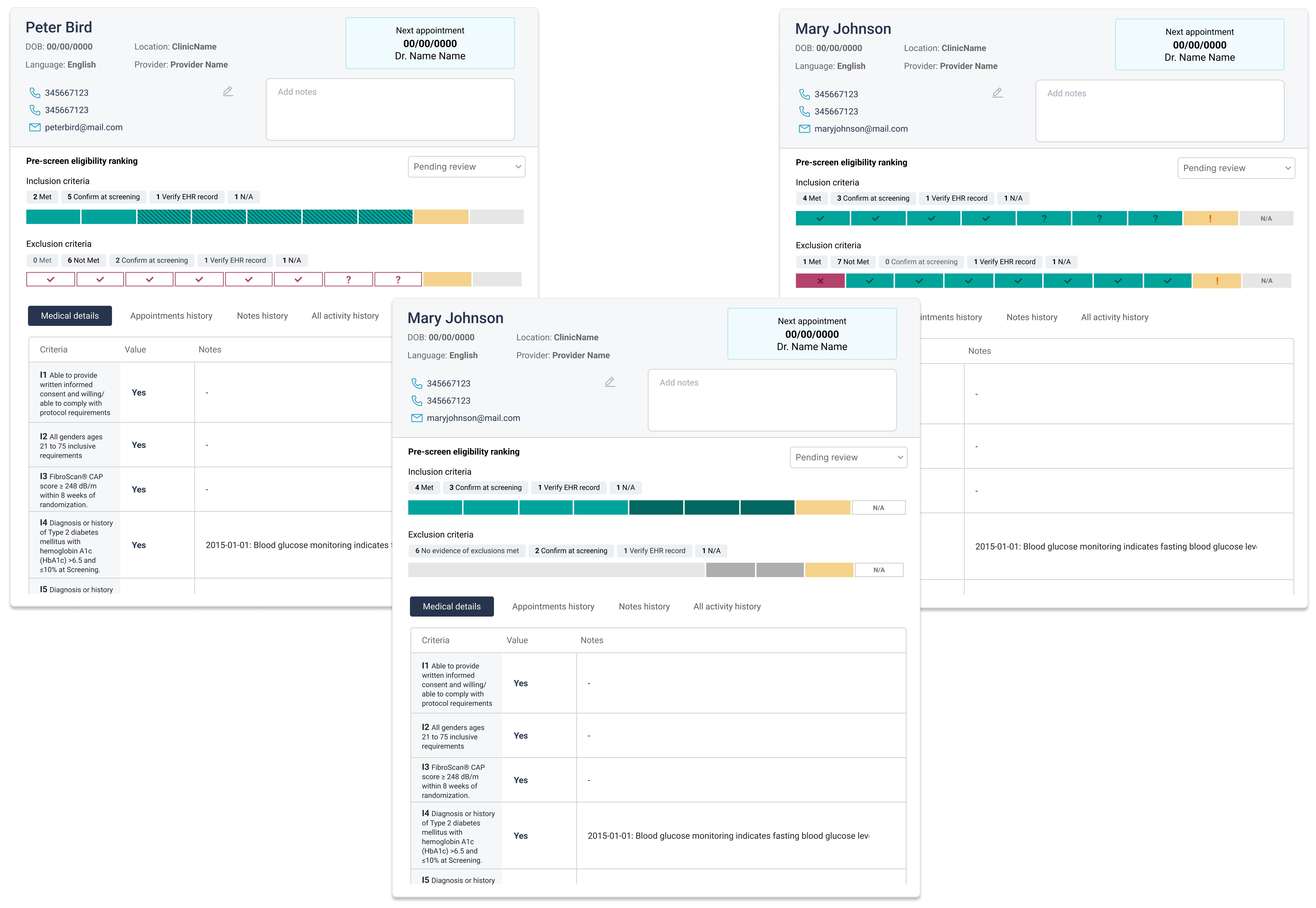
This led to a side-by-side layout: one side for the participant list providing an overview of relevant information for prioritization of most likely eligible participants and the other side showing detailed information about the selected participant.
From prototyping to MVP
I moved quickly to prototyping and performing a few usability tests in order to validate the overall structure and ensure that flows, language, and labels were clear and actionable. The test resulted in the need to add more helper text throughout the interface considering the lack of standard in recruitment flows there wouldn’t be a single label that would satisfy all users.
We decided to released an MVP to a small user group for deeper interface and data analysis testing, tracked through Mixpanel and continuous user feedback.
Key finding from the MVP
Rigid tiers
One major insight from the MVP involved the eligibility determination feature. The version users tested applied a TIERED ranking to pre-screen and prioritize candidates before recruitment teams began their own analysis.
Users found the tiers too rigid, which caused them to miss good candidates or encounter false positives.
Redesign of the eligibility feature
The product team worked closely to resolve this issue. We had to consider the subjectivity of eligibility assessments while still saving users time and helping them focus on likely matches.
We replaced the tiered system with a matching scale to show how well each participant fit the protocol criteria. This scale appeared in the participant table and the individual details view. In the latter, the scale was broken down to show which specific criteria were met or not, along with the medical evidence supporting it.
Recruit V1, product highlights
The status tracking feature was reworked to be more recognizable and informative helping users monitor the eligibility analysis process, prioritize their work, and stay within the platform for more of their workflow.
Users reported that the first version proposed for the statuses were often missed or too specific, so all the we grouped all statuses into three main tiers: approved, pending, and ineligible. Each tier included subcategories, plus a custom option.
The eligibility scale was redesigned to integrate directly with the medical details section, creating a seamless link between protocol criteria and clinical evidence.
This made it easier for users to navigate and direct their work, while overall UI refinements improved clarity and usability.
Impact and reflection
The product was adopted across multiple organizations and sites. Users reported a significant workflow improvement, especially in being able to find key information in one place instead of digging through EHRs and notes.
They also valued the ability to track participant status individually and as a team, using activity logs to see updates and allowing managers to report progress more easily to sponsors.
Reported improvement metrics:
From 18 to 4 months
Time to reach recruitment goals was reduced by up to 30% reducing the total time from 18 to 4 months
20% less screen failure
The process showed better quality candidates and up to 20% less screen failure rates in clinical trials
Personal reflection
This project was fascinating. I built the product from scratch as the sole designer while working deeply with data science and engineering.
It was also challenging. Design decisions had to happen alongside data model development and backend engineering.
I relied heavily on design fundamentals, known usability patterns, and a clear UI hierarchy to guide the user through a highly technical and fast-paced workflow.